Try TAP free
The operating system for serious music PR work.
Run campaigns, protect relationships, learn what worked.
Built by a working radio plugger, for the people doing the job.


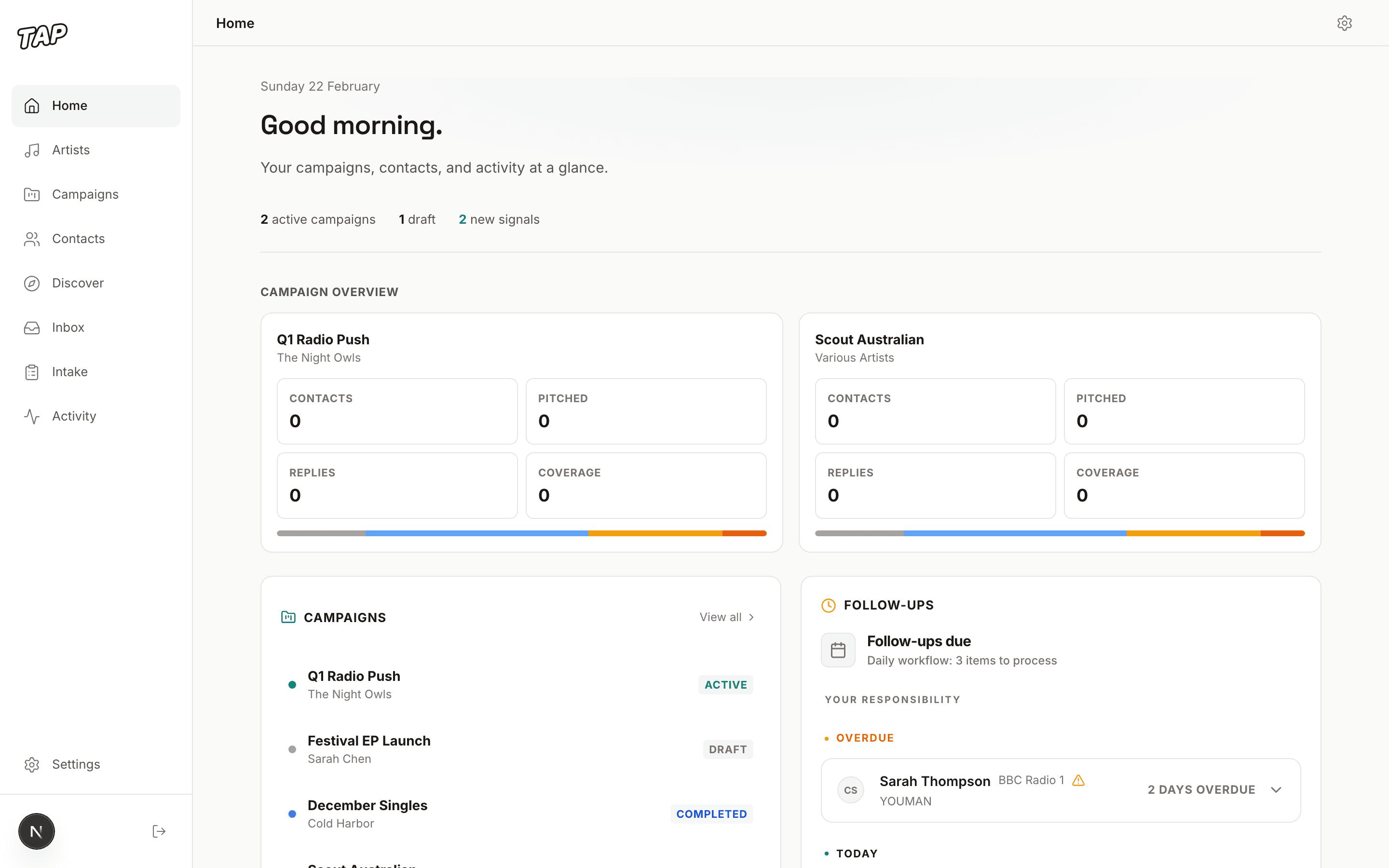
Run it yourself, or let an agent help.
The workspace is the product. The extras below are for the days you want a hand. Ignore them if you don’t.
Write down how you work.
Set tone, send-windows, the outlets you never bother. The workspace and any agent reads these first, so the work stays in your voice.
Plug in Claude, Cursor, or any agent you like.
Bring your own agent. It can read your contacts, draft pitches, and queue them for your approval. Nothing sends without your say-so.
One link the artist can check anytime.
Plays, replies, coverage. Fresh every visit. Replaces the weekly status email and the screenshot dump.
Catch plays automatically.
TAP listens to UK community and commercial radio and matches plays to your campaign. No manual logging, no chasing producers for confirmation.
A campaign compounds every time you run one.
A system that gets smarter with every campaign. Four steps, each feeding the next.
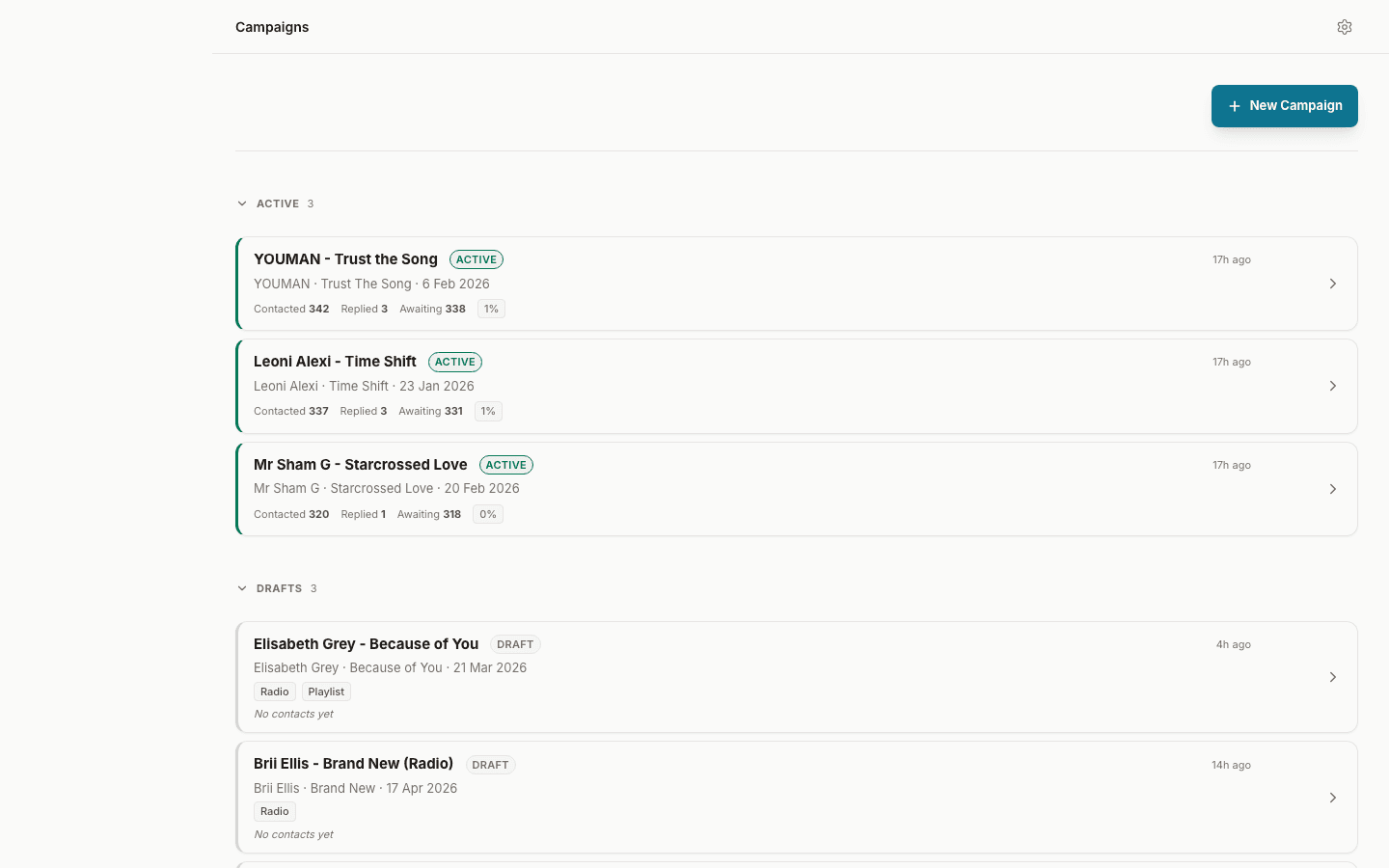
Start a campaign from the release
Drop a Spotify link, a brief, or a release date. TAP builds the prep, target outlets, draft angles, send window, around the track.
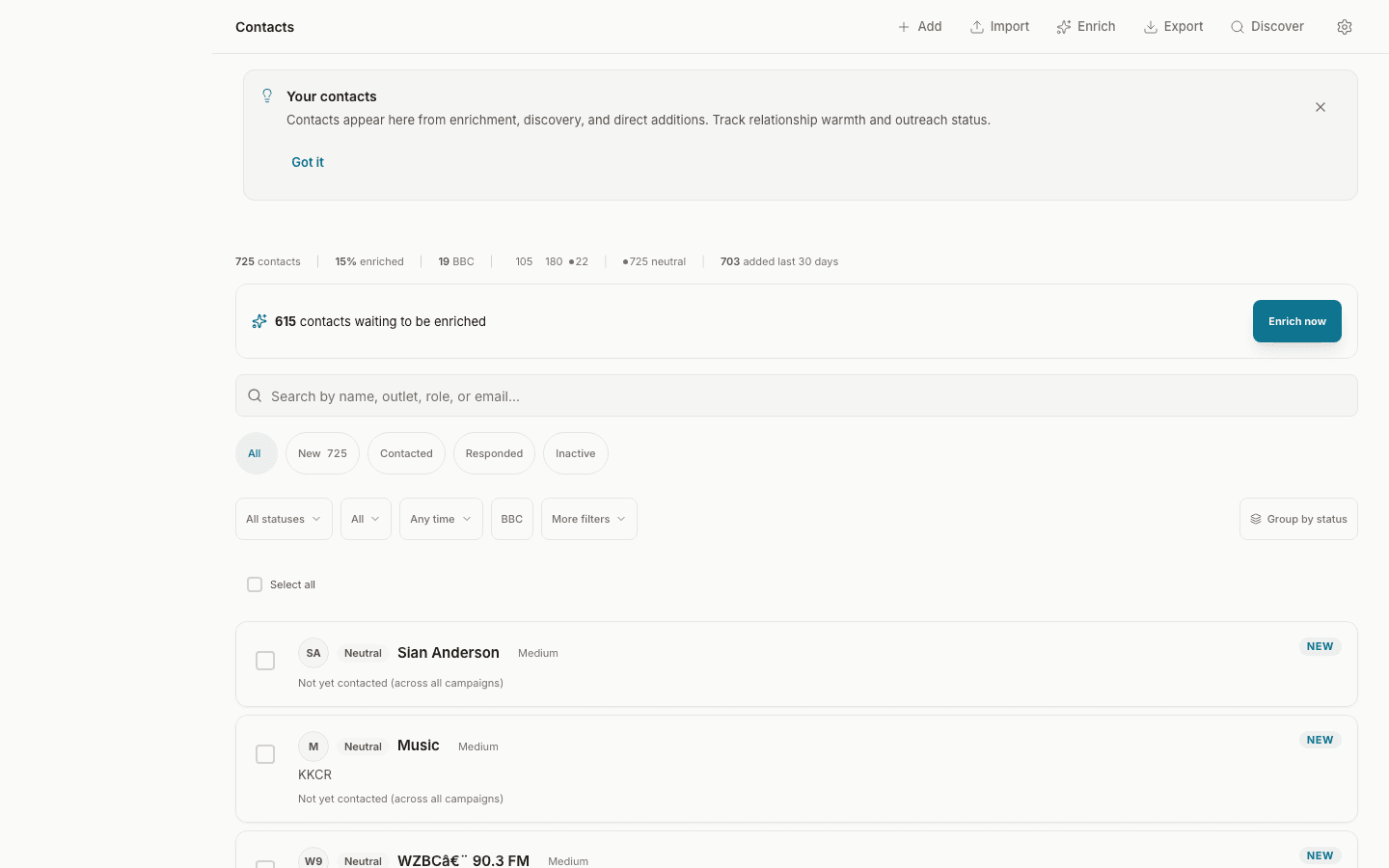
Build a contact list that actually knows the outlet
Import from Airtable or CSV, or add contacts directly. TAP enriches each one with up to 14 data points: verified email, role, submission preferences, pitch tips, and relationship history.
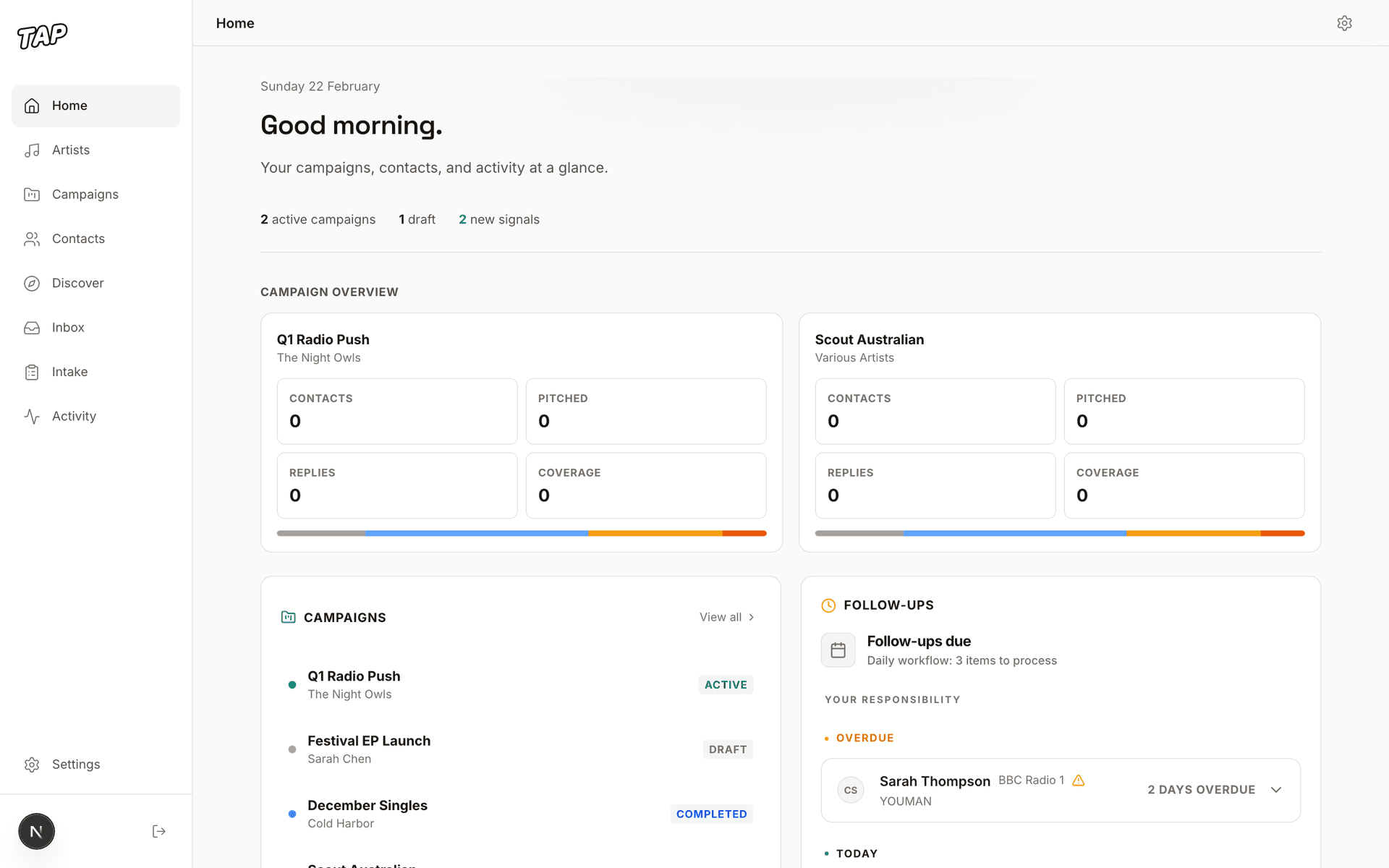
Send pitches that read like you wrote them
Drafts use the contact's format, the track's angle, and your own phrasing. See who replied, who passed, and who's owed a follow-up.
Close the loop with plays, coverage, and a client report
Plays pulled from monitoring. Coverage logged against the campaign. The end-of-run report writes itself from what actually happened.
 TAP Pro£39/mo
| Tool | Monthly | In TAP |
|---|---|---|
| Gmail | £0 | Outreach inbox, per campaign |
| Airtable | £20 | Contacts with 14 data points |
| CoverageBook | £99 | Coverage timeline + auto-report |
| Chartmetric | £20 | Radio plays timestamped to pitches |
| WARM | £10 | Radio monitoring, per campaign |
| Google Drive | £0 | Release assets, per brief |
| Notion | £0 | Campaign timeline, shared |
| Google Docs | £0 | Drafts per contact, per format |
| Total stack | £149/mo | TAP Pro · £39/mo |
Replace the stack 7 tools → TAP Pro £149/mo £39/mo | ||
“Spreadsheets don’t remember who ghosted you last time.”
Every campaign should make the next one easier. That only works if your tools actually remember what happened.
Nine capabilities. Zero add-ons.
“Thanks, I’ll give it a spin this week. Send the next one our way.”
14 data points per contact, parsed on import.
Genre, format, recent plays, preferred pitch style, last reply, blocked domains. Every contact carries the context the pitch needs.
Radio plays tracked across UK stations.
Monitoring across regional, national, and specialist shows. First play is timestamped against the pitch that triggered it.
Drafts that sound like you.
Set tone once. Every draft adapts to your phrasing, register, sign-off.
Your tone, their format.
Drafts use the contact's submission preferences. Edit in place, send, log.
Clippings with full campaign context.
Who wrote it, which pitch, which track, which week. Ready for the report.
Client-ready without a weekend of copy-paste.
Plays, coverage, replies, narrative. PDF or share a link.
Press release drafted and exported in the same system.
Generate from campaign context. Edit in place. Export as PDF or share a link. No switching to Google Docs.
Replies attributed to the right contact and campaign.
Connect via IMAP app password. TAP reads your pitch replies and attributes each one automatically. No filter setup, no inbox forwarding.
Built by a plugger, not a tech company.

TAP is built by Chris Schofield, a UK radio plugger turned indie developer. Five years pitching BBC Radio 1 and 6 Music, two kids, one full-time job, and a long-standing irritation with how much of music PR still happens in spreadsheets.
Most agencies run campaigns across Gmail, a play tracker, CoverageBook, three spreadsheets, and Drive. Context drops between every step. TAP keeps it in one place: contacts, drafts, replies, plays, coverage, and the report you send the client at the end. Same place, same campaign, same memory.
No hype. No one-click promo. The work still takes taste and relationships. TAP just stops the tools fighting you.
I’m a freelance plugger. I built TAP because nothing else fit the job.
I’m Chris. I run campaigns at a small UK music PR agency as a freelance radio plugger. Before that, five years pitching BBC Radio 1 and 6 Music.
I built TAP because the tools I had were designed for a different job. Gmail for outreach, a spreadsheet for contacts, CoverageBook for press, WARM for radio monitoring, Drive for everything else. Every handoff between them dropped context. By the time a campaign finished, I’d rebuilt the same information four times and still couldn’t tell you, reliably, who had replied to what and when.
I built TAP for the job I actually do. These numbers are from that workspace. Real campaigns, real contacts, no identifiers. If it passes the test of running live campaigns day to day, it’s ready for yours.
Open by design.
Your contacts, unlocked
Enriched contacts accessible from anywhere. API, CSV, or the workspace. Not trapped in another tool's database.
Run campaigns your way
Some agencies use the workspace. Some use scripts. Some run them through an agent. TAP supports all three.
Context that compounds
Every send, reply, and outcome feeds back into contact intelligence. The system remembers what worked.
Three tiers. Real numbers.
One seat replaces the typical £149/mo stack. Upgrade when the campaign volume asks for it, not before.
- 1 active campaign
- 50 contact imports
- Drafts, replies, plays
- PDF client report
- 10 active campaigns
- 200 contact enrichments
- Unlimited pitches and replies
- Coverage timeline, shared reports
- Email support
- Unlimited campaigns
- 1,000 contact enrichments
- Team seats, shared inbox
- Client-branded reports
- Onboarding call
Built for agencies who already know the work.
- Independent PR agencies running multiple campaigns at once
- Radio pluggers keeping dozens of producer relationships warm
- Press agents tired of stitching spreadsheets to Mailchimp and Gmail
- Anyone who needs coverage reports that don’t take half a day to build
- Anyone chasing volume over judgement
- Anyone who wants to automate relationships
- Indie labels running their own releases
Straight answers.
answered
01Is this another CRM?
No. TAP is not a CRM, not a sales pipeline, not a task manager. It's built for music PR workflows: research, drafting, tracking, client reporting. CRMs treat contacts like leads. In music PR they're relationships you keep for years.
02Does TAP send emails automatically?
Never. TAP drafts and gives context. Every message goes through you. Nothing leaves without your say-so.
03What does TAP replace?
Most agencies use 5 to 7 tools: Gmail for outreach, a play tracker for radio, CoverageBook for press, spreadsheets for contacts, Mailchimp for lists, Drive for campaign notes. TAP consolidates all of this into one system where context carries between steps.
04How does contact enrichment work?
Import a CSV or paste a list of names. TAP enriches each contact with up to 14 data points: verified email, role, outlet, submission preferences, pitch tips, social profiles. Each data point shows a confidence score and source.
05Is my data secure?
Encrypted at rest and in transit. Row-level security keeps your workspace yours. UK GDPR compliant. We never share or sell contact data between workspaces.
06What happens if I cancel?
You keep access to your data on the free tier. You can export all contacts as CSV at any time, on any plan. Nothing is held hostage.
07Do you comply with GDPR?
Yes. TAP is UK-registered and operates under UK GDPR. Data is processed for legitimate business interest. You can delete any contact at any time.
08Can I use TAP for press as well as radio?
Yes. Radio plugging, press, playlist pitching, blog outreach. Enrichment and drafts adapt to the contact type.